


























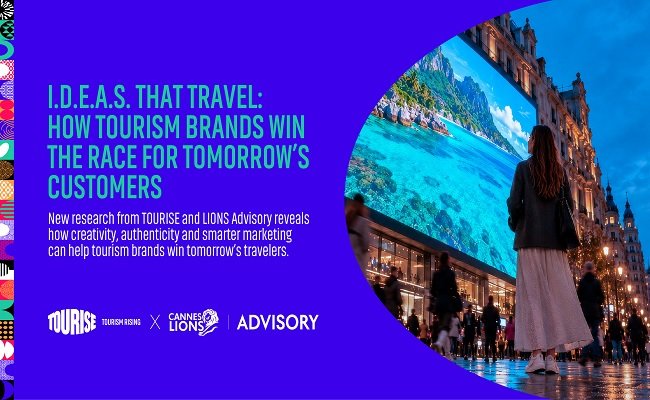
Tourise, the world’s premier platform for shaping the future of global tourism, has released ‘IDEAS That Travel’ – a new report developed in collaboration with LIONS Advisory. The study finds that while travel demand is rising, tourism brands are competing for attention in a more fragmented, socially driven and AI-mediated environment, where visibility alone is no longer enough to secure preference and growth.
“Travellers are discovering destinations earlier and through more channels than ever, from social feeds and creators to communities and AI tools. That raises the bar for tourism brands. Creativity, distinctiveness and trust are becoming central to how destinations earn attention, build preference and remain relevant across the entire traveler journey,” said Ahmed Al Khateeb, Minister of Tourism of Saudi Arabia and Chairman of TOURISE.
‘IDEAS That Travel’ draws on an online survey of 8,374 consumers across 13 markets who had traveled internationally in the previous 12 months, conducted in December 2025, alongside in-depth interviews with global industry leaders and analysis of LIONS’ marketing research and case studies.
Interviewees include Tony Fernandes, CEO of Capital A and Co-Founder of AirAsia; David Droga, Vice Chair of Accenture; Gonzalo Brujó, CEO and Global Chairman of Interbrand; and Joanne Chehab, Head of MENA Global Business Solutions at ByteDance / TikTok.
The opportunity is significant, but so is the competition. Thirty-nine percent of travellers expect to travel more in the next 12 months than they did in 2025, rising to 51% of Gen Z and 47% of Millennials. Yet tourism marketing is struggling to stay memorable and distinctive: 60% of travelers say travel ads look similar, 43% find it hard to distinguish between travel brands, and 50% cannot remember the last tourism advertisement they saw, with a further 7% unsure.
At the same time, 55% of travellers already use AI in holiday planning and 62% expect to use it more often over the next year. The report argues that future growth will depend on brands building relevance before travelers enter the booking funnel, and doing so consistently across human and AI-led discovery.
“Creativity is a commercial advantage,” said Paul Coxhill, Chief Operating Officer & President, LIONS. “Numerous empirical studies evidence creativity’s role in business growth. The tourism sector is fertile ground for creative effectiveness. Few categories deal so directly in emotion, experience, and memory. Yet in recent years, the sector has seen massive shifts in how people discover, book, and engage with destinations. While demand is rising, so is competition and complexity.”
The report also identifies a widening visibility challenge. Global travel and transport advertising spend rebounded to an estimated $32.4 billion in 2025, but the category’s share of voice remains below pre-pandemic levels. Restoring it to 3% would require investment to reach $43.4 billion by 2027, an $11 billion increase in two years. The report stresses that the answer is not simply more spend, but smarter investment in the social, creator, video and entertainment-led environments where travel intent increasingly forms.
Case studies from Airbnb, Tourism Australia, Visit Sweden, Visit North Carolina and Southwest Airlines show how the principles can be applied in practice. The report concludes that the tourism brands best positioned for future growth will compete not only for bookings, but for attention and cultural relevance, connecting storytelling, creators, AI, media and the lived experience into one coherent system.