
































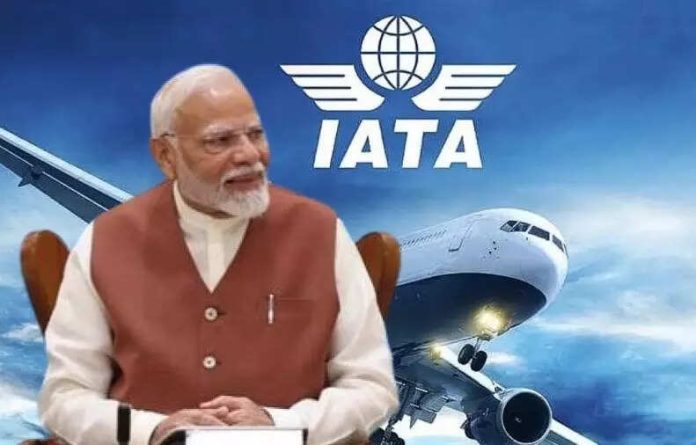

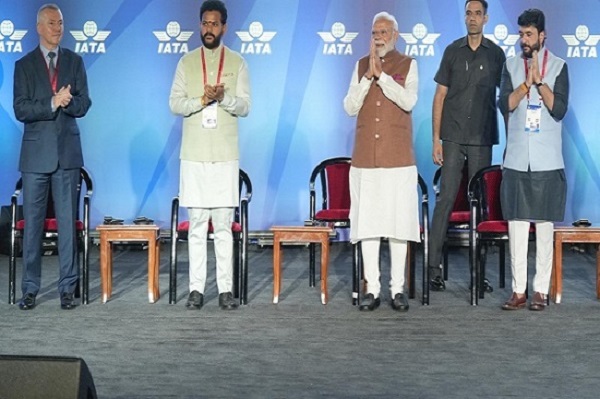
In line with his commitment to developing world-class air infrastructure and enhancing connectivity, Prime Minister Narendra Modi addressed the International Air Transport Association’s (IATA) 81st Annual General Meeting (AGM) and the plenary session of World Air Transport Summit (WATS) at Bharat Mandapam in New Delhi.
Speaking at the event, the Prime Minister welcomed guests, highlighting the significance of the event returning to India after four decades. He emphasized the transformative changes India has undergone during this period, stating that today’s India is more confident than ever.
He underscored India’s role in the global aviation ecosystem, not only as a vast market but also as a symbol of policy leadership, innovation, and inclusive development. “Today, India is emerging as a global leader in space-aviation convergence”, remarked the Prime Minister, noting that the civil aviation sector has witnessed historic advancements over the past decade, which are well recognized.
Key Points
-
India is emerging as a leading force in the Global Space-Aviation convergence
-
India today is the world’s third-largest domestic aviation market
-
The success of the UDAN scheme is a golden chapter in Indian civil aviation
-
For the world’s leading aviation companies, India presents an excellent opportunity for investment
Emphasizing that this summit and dialogue serve as a platform not only for aviation but also for advancing global cooperation, climate commitments, and equitable growth, the Prime Miniter highlighted that discussions at the summit will provide new direction to global aviation, unlocking its infinite possibilities and optimizing its potential.
He remarked on humanity’s ability to cover vast distances and intercontinental journeys in mere hours, stressing that the aspirations of the 21st century continue to evolve beyond conventional travel. He noted the rapid pace of innovation and technological advancements, stating that as speed increases, distant destinations are becoming our destiny.
The Prime Minister outlined three foundational pillars driving India’s aviation sector, first, a vast market—not merely a collection of consumers but a reflection of India’s aspirational society. Second, a strong demographic and talent pool—where young innovators are pioneering breakthroughs in artificial intelligence, robotics, and clean energy. Third, an open and supportive policy ecosystem—enabling industrial growth.
The Prime Minister highlighted India’s remarkable transformation in civil aviation over the past years. He added, “India has become the third-largest domestic aviation market in the world”. Emphasizing the success of the UDAN scheme, calling it a golden chapter in Indian civil aviation history, he stated that under this initiative, over 15 million passengers have benefitted from affordable air travel, enabling many citizens to fly for the first time.
The Prime Minister remarked that India’s airlines continue to achieve double-digit growth, with 240 million passengers flying annually—surpassing the total population of most countries worldwide.
He projected that by 2030, this number is expected to reach 500 million passengers. The PM noted that 3.5 million metric tons of cargo are transported by air annually in India and this volume is set to increase to 10 million metric tons by the end of this decade.
Emphasizing that these figures are not just statistics but a reflection of India’s immense potential, the Prime Minister highlighted that India is actively working on a futuristic roadmap to maximize this potential. He underscored India’s investment in world-class airport infrastructure, noting that in 2014, the country had 74 operational airports, which has now expanded to 162.

“India’s airports now have an annual handling capacity of 500 million passengers and is among the few nations setting new standards in user experience through technology”, exclaimed the Prime Minister, stating that equal priority is being given to safety, efficiency, and sustainability. He further underscored India’s transition towards sustainable aviation fuels, investment in green technologies, and efforts to reduce carbon footprint.
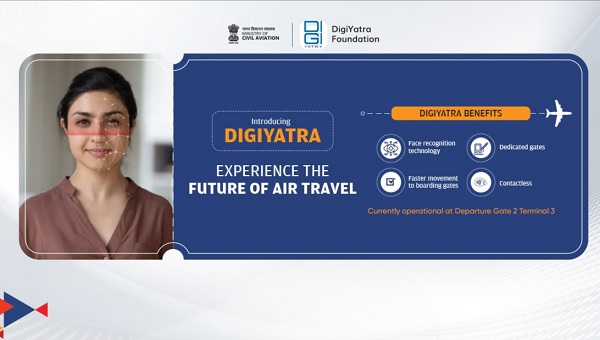
Urging international guests to familiarize themselves with the Digi Yatra app, highlighting it as a pioneering example of digital aviation, the Prime Minister emphasized that Digi Yatra provides a complete, seamless travel solution using facial verification technology, enabling passengers to navigate airport entry to boarding gates without requiring paper documents or ID display.
The Prime Minister also pointed to the emergence of Maintenance, Repair, and Overhaul (MRO) as a sunrise sector, highlighting that India is accelerating efforts to become a global hub for aircraft maintenance. He noted that in 2014, India had 96 MRO facilities, which has now increased to 154 while 100% FDI under the automatic route, GST reduction, and tax rationalization measures have given fresh momentum to India’s MRO sector. Modi further outlined India’s goal to establish a $4 billion MRO hub by 2030, reinforcing the nation’s aviation growth strategy.
Stressing that India should not be viewed merely as an aviation market but as a value-chain leader, the Prime Minister said, from design to delivery, India is becoming an integral part of the global aviation supply chain. He asserted that India’s direction and pace are on the right track, expressing confidence in the nation’s continued rapid progress. Modi urged aviation companies to not only embrace ‘Make in India‘ but also ‘Design in India’, reinforcing the vision of India’s leadership in global aviation innovation.
The Prime Minister underlined that India’s aviation sector is strengthened by its inclusive model, with over 15% of pilots in India are women, which is three times the global average. He emphasized that while the global average of women in cabin crew is around 70%, India’s figure stands at 86%.
IATA Annual General Meeting
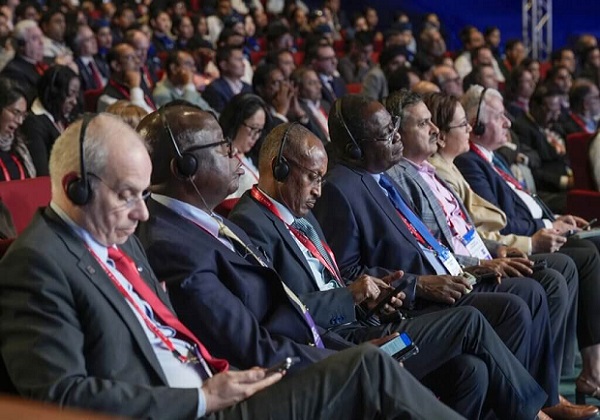
The International Air Transport Association’s (IATA) 81st Annual General Meeting and World Air Transport Summit (WATS) is being held from 1st to 3rd June. The last AGM in India was held 42 years ago in 1983. It brings together more than 1,600 participants including top global aviation industry leaders, government officials and international media representatives.
The World Air Transport Summit will focus on key issues facing the aviation industry including Economics of the Airline industry, Air Connectivity, Energy Security, Sustainable Aviation Fuel Production, Financing Decarbonisation, Innovations among others. The aviation leaders and media representatives from around the world will also get to witness India’s remarkable transformation in the aviation landscape and its contribution to the country’s socio – economic development.